

Cagrilintide and CagriSema: The Amylin Analogue That Is Not a Stronger GLP-1, and the Safety Table Nobody Quotes
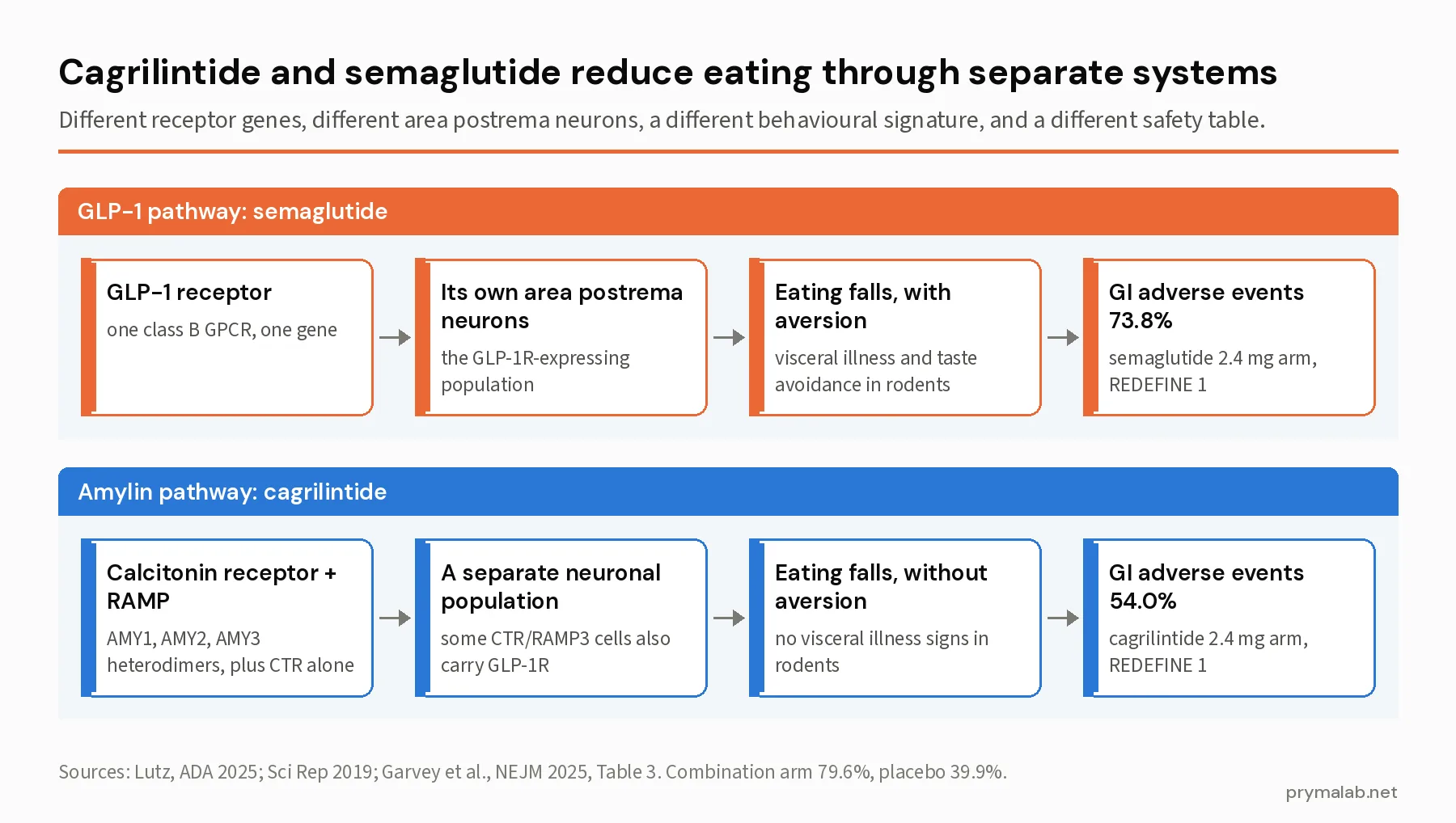
The standard summary of cagrilintide is that it is a weight-loss peptide that works well combined with semaglutide. That is true, and it misses what makes the compound interesting. Amylin is not a variant of the incretin pathway: it signals through calcitonin receptor complexes, on a separate population of neurons in the area postrema, and in rodents it reduces eating without the taste aversion GLP-1 agonists produce. Treating cagrilintide as a stronger semaglutide gets the pharmacology backwards. And there is a number in the REDEFINE 1 safety table that almost nobody quotes: cagrilintide alone produced gastrointestinal adverse events in 54.0% of patients, semaglutide alone in 73.8%, inside one trial.
Research-use-only disclaimer: Cagrilintide supplied as a research chemical is intended strictly for in-vitro and laboratory research use and is not intended for human or veterinary use. The clinical trial results described below concern investigational drug products, cagrilintide and the combination CagriSema, administered under medical supervision in registered trials, and do not describe or support any use of research-grade material. No dosing or administration guidance appears in this article; trial dose arms are reported as study design facts. Nothing here is medical advice.

TL;DR
Cagrilintide is a 37-residue amylin analogue carrying six substitutions against human amylin and a C20 fatty diacid on its N-terminus, which takes the human half-life from pramlintide's 48 minutes to 159 to 195 hours. It is a dual amylin and calcitonin receptor agonist, equipotent at the two (EC50 49 pM and 62 pM), and it has no action at the GLP-1 receptor. In REDEFINE 1, the combination CagriSema produced 22.7% weight loss at 68 weeks on the trial-product estimand against guidance of 25%, and Novo Nordisk's shares fell about 20% in a day. In the same trial, cagrilintide monotherapy produced gastrointestinal adverse events in 54.0% of patients against 73.8% on semaglutide, the strongest internally controlled tolerability evidence for the amylin pathway. Two open-label head-to-head trials against tirzepatide missed a primary endpoint. CagriSema is not approved anywhere: the NDA went to the FDA in December 2025 and a US decision is expected in Q4 2026. Research use only.
Class: Lipidated amylin analogue; dual amylin and calcitonin receptor agonist. No activity at the GLP-1 receptor.
Half-life: 159 to 195 hours in humans, against about 48 minutes for pramlintide, the only amylin analogue ever approved.
REDEFINE 1 trial: 3,417 patients, 68 weeks. CagriSema 22.7% (trial-product) or 20.4% (treatment-policy); semaglutide 16.1%; cagrilintide 11.8%; placebo 2.3%.
Tolerability: Cagrilintide alone: 54.0% GI adverse events and 2.6% discontinuation, against 73.8% and 3.6% for semaglutide alone in the same trial.
Head-to-head: REDEFINE 4 missed non-inferiority to tirzepatide 15 mg on weight (23.0% vs 25.5%). REIMAGINE 4 met it on weight and missed on HbA1c.
Regulatory: Not approved in the US or EU. NDA submitted December 2025; US decision expected Q4 2026; EU pathway pending REDEFINE 3.
Litigation: On 29 July 2026 a US federal judge let shareholder claims proceed on the dose-adjustment disclosure; the efficacy claim was dismissed.
Status: research use only.
What Cagrilintide Is, Chemically
Cagrilintide is a synthetic 37-amino-acid analogue of human amylin, the hormone that pancreatic beta cells release alongside insulin after a meal. Six residues are substituted and the N-terminal lysine carries a C20 fatty diacid on a gamma-glutamate linker, which turns a hormone with a half-life of minutes into a once-weekly candidate. It is an amylin analogue and a calcitonin receptor agonist. It is not a GLP-1 receptor agonist, not an incretin and not a variant of semaglutide.
The amylin peptide it is built from
The amylin peptide, also called islet amyloid polypeptide or IAPP, is 37 residues long with a disulfide bridge between Cys2 and Cys7 and an amidated C-terminus.[1] The pramlintide label says amylin "is colocated with insulin in secretory granules and cosecreted with insulin by pancreatic beta cells in response to food intake," and that it slows gastric emptying, suppresses glucagon and modulates appetite centrally.[2] The widely quoted 1:100 amylin-to-insulin ratio is contested: a 2022 review gives approximately 1:100,[3] a 2024 review gives 2 to 5%, with a native half-life of about 13 minutes,[1] and I am not presenting either as settled.
Why human amylin aggregates, and the rodent trick that fixed it
Human amylin is amyloidogenic. The problem region spans residues 20 to 29, with the core at residues 22 to 27, NFGAIL, which forms fibrils on its own, and the resulting oligomers contribute to beta-cell loss in type 2 diabetes.[4] Rat and mouse amylin does not fibrillise, because rodent IAPP carries prolines at positions 25, 28 and 29, and proline is a beta-sheet breaker. Position 25 appears to matter most: a pramlintide variant retaining only Pro25 still resisted aggregation.[4] Every amylin analogue in the clinic descends from that observation.
The modification list, residue by residue
Novo Nordisk's medicinal chemistry paper, which reports cagrilintide as compound 23, describes a Glu14 and Arg17 pair forming a salt bridge that stabilises the helical core, the three rodent prolines, a C-terminal proline at 37, and N-terminal acylation through a gamma-glutamic acid linker to a C20 fatty diacid.[5] A 2025 cryo-electron microscopy study independently confirms N14E and V17R as helix-stabilising, the proline at 37, the linker and the diacid.[6]
| Position | Human amylin | Cagrilintide | What the change does |
|---|---|---|---|
| 1 (N-terminus) | Lys, free amine | Lys, acylated: gamma-Glu linker to a C20 fatty diacid | Albumin binding, protraction; stronger calcitonin receptor engagement |
| 2 and 7 | Cys-Cys disulfide | Unchanged | The native N-terminal loop |
| 14 and 17 | Asn, Val | Glu, Arg | Salt bridge; stabilises the helix |
| 25 | Ala | Pro | Anti-fibrillation; the most important |
| 28 and 29 | Ser-Ser | Pro-Pro | Anti-fibrillation, shared with pramlintide |
| 37 (C-terminus) | Tyr amide | Pro amide | C-terminal proline; the amide is retained |
Written out, the backbone is KCNTATCATQRLAEFLRHSSNNFGPILPPTNVGSNTP-NH2, against KCNTATCATQRLANFLVHSSNNFGAILSSTNVGSNTY-NH2 for human amylin. The IUPAC name PubChem lists reads back to the same sequence and acylation site, and PubChem gives C194H312N54O59S2 and a molecular weight of about 4,409 g/mol for the free peptide.[7]
What the acyl chain buys
The diacid drives reversible albumin binding, as in semaglutide. In rats the half-life is 20 ± 2 hours intravenously and 27 ± 3 hours subcutaneously.[5] In humans it is 159 to 195 hours, about 6.6 to 8.1 days, which is why every trial has been once weekly.[8] Pramlintide's label gives about 48 minutes.[2] That is roughly a 200-fold extension from one lipid and one linker. AM833 and NN9838 are the development codes; CagriSema is the once-weekly combination of cagrilintide 2.4 mg and semaglutide 2.4 mg that phase 3 tested. At 37 residues cagrilintide sits inside the FDA's 40-amino-acid boundary for the word peptide, which our reference on what counts as a peptide explains.
Cagrilintide Mechanism of Action: Calcitonin Receptor Complexes, Not GLP-1
The cagrilintide mechanism of action runs through the calcitonin receptor and the three amylin receptors, which are the calcitonin receptor in complex with a receptor activity-modifying protein. It has no action at the GLP-1 receptor. The satiation signal enters the brain at the area postrema, on neurons largely separate from the ones GLP-1 agonists engage, and in rodents it reduces eating without the visceral illness that GLP-1 agonists produce.
There is no amylin receptor gene
Amylin receptors are heterodimers. The calcitonin receptor, a class B G protein-coupled receptor, pairs with one of three receptor activity-modifying proteins: AMY1 is the calcitonin receptor with RAMP1, AMY2 with RAMP2 and AMY3 with RAMP3. Signalling runs through Gs and cAMP; AMY1 is also activated by CGRP.[3] "An intact AP, but not vagal or non-vagal afferents, is required for amylin-induced satiation," with downstream signalling through the nucleus tractus solitarius and the lateral parabrachial nucleus.[3]
The receptor profile is genuinely non-selective
The medicinal chemistry paper reports a functional EC50 of 49 pM at the human AMY3 receptor and 62 pM at the human calcitonin receptor, with binding IC50 values of 348 pM and 287 pM; potencies at AMY1 and AMY2 were not reported.[5] A selectivity ratio of about 1 makes cagrilintide a dual amylin and calcitonin receptor agonist, a DACRA. The 2025 cryo-EM work adds that it activates the calcitonin receptor and all three amylin receptor subtypes, and that the non-lipidated backbone "exhibited a reduced potency relative to Cagri in cells expressing CTR alone," so the acyl chain contributes to receptor engagement as well as to protraction.[6]
Five lines of evidence that amylin and GLP-1 are separate pathways
The receptors are different proteins from different genes, and the neurons are different too. Thomas Lutz, presenting the mechanism session at the ADA meeting in June 2025, put it as "glucagon-like peptide-1 receptor and calcitonin receptor activate separate neuronal population in AP," with the caveat that some calcitonin receptor and RAMP3-expressing cells appear to co-express GLP-1R.[10]
The behavioural signature is the clearest separation. Amylin "reduces eating in rodents without any sign of visceral illness, taste avoidance or taste aversion," whereas GLP-1 and its agonists "reduce eating but also induce signs of visceral illness, taste avoidance and taste aversion."[10] The two pathways add in vivo: in diet-induced obese rodents the combination gives additive efficacy, and in non-human primates it outperformed either compound alone.[10] An independent 2019 study found the two hormones target different dorsal vagal complex neurons, and that the combination "significantly augmented the number of c-Fos-expressing neurons" in the nucleus tractus solitarius, p<0.05.[11]
Pramlintide Proved the Pathway and Failed on Pharmacokinetics
Pramlintide, sold as SYMLIN, is the only amylin analogue that has ever been approved: by the FDA on 16 March 2005, as an adjunct for type 1 and type 2 diabetes patients using mealtime insulin.[2] It acts through the same receptors as cagrilintide and carries the same three rodent prolines. Its half-life is about 48 minutes, and that one number explains the mealtime injections, the boxed warning, and why every US formulation is now listed as discontinued.
| Pramlintide (SYMLIN) | Cagrilintide | |
|---|---|---|
| Substitutions vs human amylin | Pro at 25, 28 and 29, from rat amylin | Pro at 25, 28, 29 and 37; Glu14 and Arg17 salt bridge |
| Lipidation | None | N-terminal gamma-Glu linker to a C20 fatty diacid |
| Half-life | About 48 minutes | 159 to 195 hours (6.6 to 8.1 days) |
| Regimen in the label or the trials | Before each major meal, on top of mealtime insulin | Once weekly in every trial |
| Warnings on record | Boxed warning: severe hypoglycaemia with insulin | No approved label; trial adverse events are gastrointestinal |
| Status, September 2026 | Approved 2005; all US formulations listed as discontinued | Not approved; CagriSema NDA under FDA review |
The label's substitution list is exactly the rodent graft: "replacement with proline at positions 25 (alanine), 28 (serine), and 29 (serine)." The boxed warning is for severe hypoglycaemia with insulin, "seen within 3 hours following a SYMLIN injection."[2] Per the FDA-derived availability record, the vial approved in 2005 and the two pens approved on 25 September 2007 are all listed as discontinued: "All of the above formulations have been discontinued."[12] I could not find a Federal Register notice or company statement giving a date or reason, so I am reporting the availability status and nothing more. A 2008 pramlintide obesity trial is often cited for effect sizes I could not open to check, so they are not here.
The lesson is narrow. Pramlintide established that amylin agonism is druggable and tolerable in humans over years of clinical use, and it failed commercially because a 48-minute half-life forced mealtime injections on top of mealtime insulin. That is a pharmacokinetics failure, not a pharmacology failure, and the modification list above was aimed at exactly that.
The Clinical Record: Phase 2 Monotherapy, the REDEFINE 1 Trial and REDEFINE 2
Cagrilintide has been through one phase 2 monotherapy trial, in which it beat liraglutide, a phase 1b in combination with semaglutide, and then the phase 3 REDEFINE programme as CagriSema. The largest of these, the REDEFINE 1 trial, randomised 3,417 adults and produced 22.7% weight loss at 68 weeks on the trial-product estimand and 20.4% on the treatment-policy estimand that was the primary analysis. Every figure here describes the investigational products studied in those trials.
Cagrilintide monotherapy beat liraglutide in phase 2
The dose-finding trial, NCT03856047, randomised 706 participants across five once-weekly cagrilintide doses (0.3 to 4.5 mg), once-daily liraglutide 3.0 mg and placebo for 26 weeks.[13] At week 26, cagrilintide 4.5 mg produced 10.8% weight loss (11.5 kg), liraglutide 3.0 mg 9.0% (9.6 kg), cagrilintide 0.3 mg 6.0% (6.4 kg) and placebo 3.0% (3.3 kg). Every cagrilintide dose beat placebo, p<0.001, and 4.5 mg beat liraglutide by 1.8%, p=0.03.[13] A once-weekly amylin analogue beat a then-approved daily GLP-1 receptor agonist at its licensed obesity dose. Gastrointestinal adverse events ran at 41 to 63% across the cagrilintide arms against 32% on placebo, and nausea at 20 to 47% against 18%.[13]
What cagrilintide adds on top of a maximal semaglutide dose
The phase 1b combination trial, NCT03600480, is the cleanest measurement of the incremental amylin effect, because its comparator arms received semaglutide 2.4 mg with a placebo in place of cagrilintide. At week 20, cagrilintide 2.4 mg plus semaglutide produced 17.1% weight loss against 9.8% for semaglutide alone, a difference of 7.4 percentage points, and the 4.5 mg cohort produced 15.4% against a matched 8.0%.[8] The amylin contribution is six to seven points, and it did not grow between 2.4 and 4.5 mg.
The REDEFINE 1 trial: 22.7%, and the estimand that matters
REDEFINE 1, NCT05567796, randomised 3,417 adults with obesity or overweight and without diabetes in a 21:3:3:7 ratio to CagriSema 2.4 mg/2.4 mg, semaglutide 2.4 mg, cagrilintide 2.4 mg or placebo, all with lifestyle intervention, for 68 weeks. The co-primary endpoints were the percentage change in body weight and the proportion losing at least 5%.[14]
| Arm | n | Trial-product estimand | Treatment-policy estimand (primary) |
|---|---|---|---|
| CagriSema 2.4/2.4 mg | 2,108 | −22.7% (−21.6 kg) | −20.4% |
| Semaglutide 2.4 mg | 302 | −16.1% | −14.9% |
| Cagrilintide 2.4 mg | 302 | −11.8% | −11.5% |
| Placebo | 705 | −2.3% | −3.0% |
The headline 22.7% is the trial-product estimand, which estimates the effect had everyone stayed on treatment. The paper's primary analysis is the treatment-policy estimand, which counts everyone regardless of adherence: 20.4% against 3.0%, a difference of 17.3 percentage points (95% CI 18.1 to 16.6, p<0.001).[14] Quoting 22.7% without naming the estimand is the kind of thing that gets an article picked apart; the monotherapy arm figures are labelled as trial-product in Novo's topline release.[15] On the treatment-policy estimand, 91.9% of CagriSema patients lost at least 5% against 31.5% on placebo. Two participants in the CagriSema arm died, one by suicide and one from a cancer of unknown primary, and none died in the other arms; I mention them as a fact of the record, not because anyone has attributed them to the drug.[14] A DXA sub-study of 252 participants found fat mass down 35.7% and lean soft tissue down 14.4%, against 5.7% and 4.3% on placebo.[15]
REDEFINE 2, in type 2 diabetes
REDEFINE 2, NCT05394519, randomised 1,206 adults with type 2 diabetes, a BMI of at least 27 and an HbA1c of 7 to 10% in a 3:1 ratio to CagriSema or placebo for 68 weeks. On the treatment-policy estimand weight fell 13.7% against 3.4%, a difference of 10.4 points (95% CI 11.2 to 9.5, p<0.001); on the trial-product estimand, 15.7% against 3.1%. HbA1c fell 1.8 percentage points against 0.4.[16] Gastrointestinal adverse events occurred in 72.5% against 34.4%, and discontinuation for adverse events was 8.4% (76 of 904) against 3.0% (9 of 302), higher than REDEFINE 1's 5.9%. Serious adverse events went the other way, 10.4% against 12.9% on placebo.[16]
| Trial | Population | n | Weeks | Comparator | Headline result |
|---|---|---|---|---|---|
| Phase 2 monotherapy (2021) | Overweight or obesity | 706 | 26 | Liraglutide 3.0 mg; placebo | Cagrilintide 4.5 mg 10.8% vs liraglutide 9.0%, p=0.03 |
| REDEFINE 1 | Obesity, no diabetes | 3,417 | 68 | Semaglutide; cagrilintide; placebo | 22.7% (trial-product), 20.4% (treatment-policy) |
| REDEFINE 2 | Type 2 diabetes | 1,206 | 68 | Placebo | 13.7% vs 3.4%; HbA1c −1.8 vs −0.4 |
| REDEFINE 4 | Obesity + comorbidity | 809 | 84 | Tirzepatide 15 mg, open-label | Non-inferiority not met: 23.0% vs 25.5% |
| REIMAGINE 1 | Type 2 diabetes | 189 | 40 | Placebo | HbA1c −1.8 vs −0.1; weight −13.8% vs −1.4% |
| REIMAGINE 2 | Type 2 diabetes | ~2,713 | 68 | Sema 2.4 and 1.0 mg; cagri; placebo | HbA1c −1.91 vs −1.76 (sema 2.4); weight −14.2% vs −10.2% |
| REIMAGINE 3 | Type 2 diabetes on basal insulin | 274 | 40 | Placebo | HbA1c −2.33 vs −0.66; weight −12.0% vs +1.1% |
| REIMAGINE 4 | Type 2 diabetes | ~1,000 | 68 | Tirzepatide 15 mg, open-label | Non-inferior on weight (15.2% vs 15.8%); not on HbA1c (1.9 vs 2.2) |
| REDEFINE 3 | Cardiovascular disease | 7,101 | up to 4.5 years | Placebo | MACE; readout expected second half of 2027 |
Cagrilintide Side Effects: The REDEFINE 1 Safety Table Nobody Quotes
The cagrilintide side effects reported in trials are gastrointestinal, mainly nausea, and they occur less often than with semaglutide. In REDEFINE 1, with four arms running concurrently, cagrilintide monotherapy produced gastrointestinal adverse events in 54.0% of patients against 73.8% on semaglutide monotherapy, 79.6% on the combination and 39.9% on placebo. Discontinuation for adverse events on cagrilintide was 2.6%, below placebo's 3.5%.
| CagriSema | Semaglutide 2.4 mg | Cagrilintide 2.4 mg | Placebo | |
|---|---|---|---|---|
| Any gastrointestinal adverse event | 79.6% | 73.8% | 54.0% | 39.9% |
| Discontinuation for adverse events | 5.9% | 3.6% | 2.6% | 3.5% |
| Gastrointestinal-related discontinuation | 3.6% | 1.3% | 1.3% | 0.6% |
| Serious adverse events | 9.8% | 5.0% | 8.9% | 6.1% |
| Deaths | 2 | 0 | 0 | 0 |
| On the maximum dose at week 68 (paper) | 57.4% | 70.9% | 82.5% | 70.6% |
| On the maximum dose at week 68 (Novo topline) | 57.3% | 70.2% | 82.5% | not quoted |
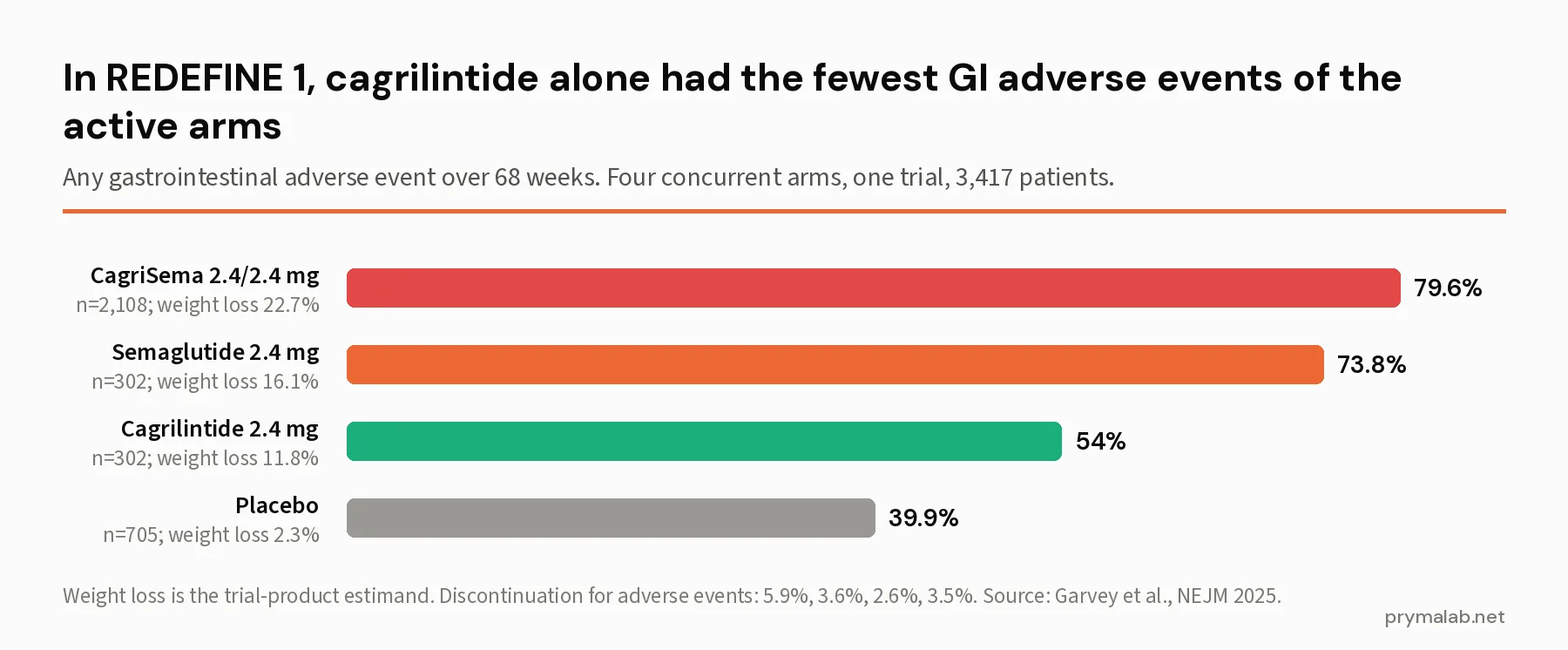
Adding cagrilintide to semaglutide costs about 6 percentage points of gastrointestinal incidence and 2.3 points of discontinuation, for 6.6 points of additional weight loss; by the standards of this class that is a favourable trade. The part that gets lost is the other comparison: cagrilintide monotherapy was better tolerated than semaglutide monotherapy on every measure in the table except serious adverse events, where it ran at 8.9% against 5.0%, a difference I cannot interpret from the published counts and will not explain away. This is the rodent taste-aversion finding showing up in a 3,417-patient human trial.
A sourcing note on the load-bearing claim. The CagriSema and placebo figures appear in the published abstract; the comparator-arm figures, 73.8% and 54.0%, sit in Table 3 of the paper, which I read in the publisher's PDF while writing this. I could not open the supplementary appendix, so per-symptom rates by arm are not available to me from the primary source.
That is the second line of evidence, and it does not depend on how adverse events were coded.[14] Novo's topline gave 57.3%, 70.2% and 82.5% for the active arms; the ordering is the same.[15] Two caveats. The trial's rules let investigators "delay dose escalation or reduce the dose if the current dose was associated with adverse effects," and also when a participant reached a low-normal BMI with a health concern, so a reduction does not always mean intolerance.[14] And 29.4% of placebo patients were not at the maximum either, a floor under how much down-titration in any arm was drug-related. Against that floor, cagrilintide patients were 12 points more likely than placebo to be at full dose and CagriSema patients 13 points less likely; that is my arithmetic on published percentages, and I am saying so.
Novo's Canadian release from June 2025 gives individual rates for CagriSema against placebo: nausea 55% against 12.6%, constipation 30.7% against 11.6%, vomiting 26.1% against 4.1%.[15] Those are company-reported until someone checks them against the NEJM appendix. In type 2 diabetes the picture is worse: REDEFINE 2's 8.4% discontinuation against 3.0%, and 72.5% gastrointestinal events against 34.4%.[16] Novo's standard line, that events were mostly mild to moderate and diminished over time, is what every sponsor in this class says.
The REIMAGINE Programme and Two Head-to-Head Misses Against Tirzepatide
CagriSema has been tested twice against tirzepatide 15 mg, both times open-label, and both times it missed a primary non-inferiority endpoint: on weight in obesity in REDEFINE 4, and on HbA1c in type 2 diabetes in REIMAGINE 4. The pre-specified non-inferiority margins have not been published for either trial, so nobody writing about them can say how close the misses were.
REDEFINE 4, in obesity
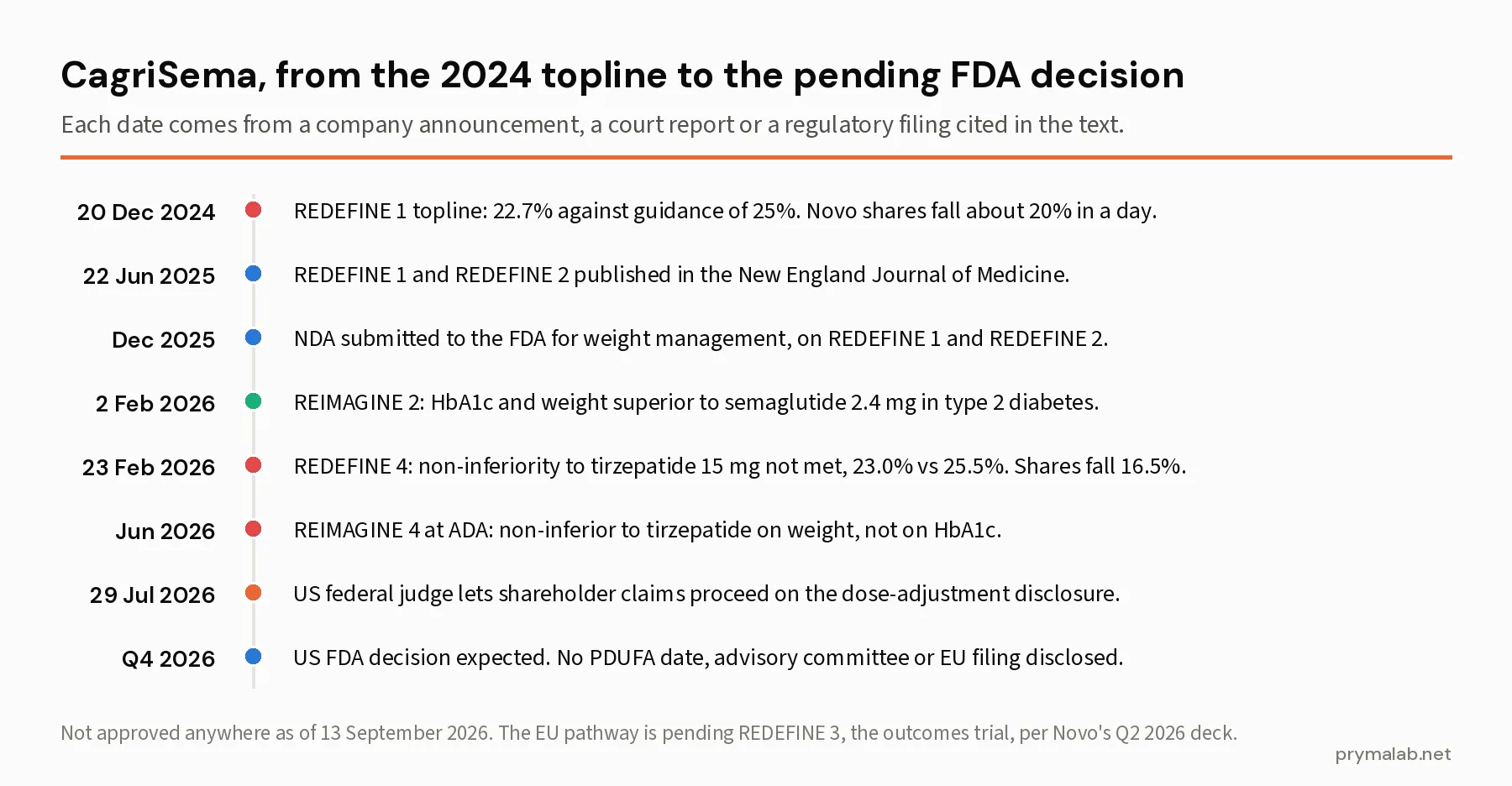
Novo announced REDEFINE 4, NCT06131437, on 23 February 2026. It was a randomised open-label trial, 1:1, in 809 adults with obesity and at least one comorbidity, mean baseline weight 114.2 kg, over 84 weeks, CagriSema 2.4 mg/2.4 mg against tirzepatide 15 mg. On the efficacy estimand CagriSema produced 23.0% weight loss against 25.5% for tirzepatide; on the treatment-regimen estimand, 20.2% against 23.6%. The company's own headline said the primary endpoint of non-inferiority was not achieved, and its Copenhagen listing fell from DKK 301.00 on 20 February to DKK 251.40 on 23 February, down 16.5%.[17] The non-inferiority margin was not disclosed in the announcement, the investor materials or any coverage I could reach.
The REIMAGINE programme, which almost nobody covered
Novo ran a second phase 3 programme in type 2 diabetes under the REIMAGINE name and presented it at the ADA meeting in June 2026. It is barely reported outside the company's own releases and holds the largest single dataset on CagriSema.[18] REIMAGINE 2, announced on 2 February 2026, randomised roughly 2,700 patients for 68 weeks against semaglutide 2.4 mg, semaglutide 1.0 mg, cagrilintide 2.4 mg and placebo: HbA1c fell 1.91 points against 1.76 on semaglutide 2.4 mg and weight fell 14.2% against 10.2%, with gastrointestinal events in 67.2% and discontinuation in 8.5% of the CagriSema arm.[18] Enrolment is 2,713 in one Novo document and 2,728 in another. REIMAGINE 3 is the one worth pausing on: in 274 patients already on basal insulin, over 40 weeks, placebo patients gained 1.1% of body weight while CagriSema patients lost 12.0%, and HbA1c fell 2.33 points against 0.66.[18] Insulin causes weight gain; this is the combination working against it.
REIMAGINE 4, the second miss
From Novo's own report for the first half of 2026: "CagriSema 2.4 mg/2.4 mg demonstrated non-inferiority versus tirzepatide 15 mg for weight reduction, but not for HbA1c reduction."[19] Roughly 1,000 patients, 68 weeks, open-label. Weight 15.2% against 15.8%, non-inferiority met. HbA1c 1.9 points against 2.2, non-inferiority not met.[18] Two head-to-head trials, two populations, two different failed endpoints, both open-label, a design that in weight-loss trials invites differential dropout and behavioural confounding. I would not call either result a rout or a near miss, because the margins that would let me choose are not public.
Where CagriSema Sits Against Retatrutide, Tirzepatide and the Other Amylin Analogues
On the headline numbers, CagriSema's 22.7% at 68 weeks sits between tirzepatide 15 mg, at 22.5% over 72 weeks in SURMOUNT-1, and retatrutide 12 mg, at 28.3% over 80 weeks in TRIUMPH-1, with discontinuation for adverse events of 5.9% against 6.2% and 11.3%. Those are cross-trial comparisons across different populations, durations and estimands, and that caveat applies to every row below.
| Compound | Trial | Weight loss | Duration | Discontinuation for adverse events |
|---|---|---|---|---|
| Retatrutide 12 mg | TRIUMPH-1 (phase 3) | 28.3% | 80 weeks | 11.3% |
| Tirzepatide 15 mg | SURMOUNT-1 (phase 3) | 22.5% | 72 weeks | 6.2% |
| CagriSema 2.4/2.4 mg | REDEFINE 1 (phase 3) | 22.7% | 68 weeks | 5.9% |
| Semaglutide 7.2 mg | STEP UP (phase 3) | 20.7% | 72 weeks | not extracted |
| Eloralintide 9 mg | Phase 2 | 20.1% | 48 weeks | not in the release |
| Semaglutide 2.4 mg | REDEFINE 1 arm | 16.1% | 68 weeks | 3.6% |
| Cagrilintide 2.4 mg | REDEFINE 1 arm | 11.8% | 68 weeks | 2.6% |
| Petrelintide (highest dose) | ZUPREME-1 (phase 2) | 10.7% | 42 weeks | 4.8% (placebo 4.9%) |
SURMOUNT-1 randomised 2,539 adults for 72 weeks.[20] TRIUMPH-1, announced on 21 May 2026, randomised 2,339 adults for 80 weeks; its 12 mg arm carried a dysesthesia rate of 12.5% against 0.9%.[21] Discontinuation tracks efficacy almost exactly across the class, and the only compound sitting off that line is petrelintide. The contrast with our reference on retatrutide and tirzepatide is worth holding: retatrutide adds a third incretin-family receptor to an incretin drug, while CagriSema adds a separate hormone system.
Semaglutide 7.2 mg is Novo's own internal comparator
Wegovy HD, semaglutide 7.2 mg, was approved in the United States on 19 March 2026, on the STEP UP trial of roughly 1,400 adults over 72 weeks: 20.7% weight loss on the efficacy estimand and 18.7% on the treatment-regimen estimand.[22] Novo now sells an approved semaglutide monotherapy at 20.7% while waiting on a decision for a CagriSema that produced 20.4% on the treatment-policy estimand. The incremental case is narrow, which is why the high-dose programmes exist.
Eloralintide asks whether the calcitonin receptor matters
Eloralintide, Lilly's selective amylin receptor agonist, produced 20.1% weight loss at 48 weeks at 9 mg as monotherapy in a 263-patient phase 2 announced on 6 November 2025, against 0.4% on placebo, with mainly mild to moderate gastrointestinal symptoms and fatigue.[9] That number sits close to cagrilintide and semaglutide combined, from a compound selective for the amylin receptors, and it is the most direct evidence that the calcitonin half of the cagrilintide profile may be merely tolerated rather than necessary.
Petrelintide is the tolerability result of the class
ZUPREME-1, announced by Roche on 5 March 2026, randomised 493 patients over 42 weeks across five doses of petrelintide, Zealand Pharma's amylin analogue: up to 10.7% weight reduction against 1.7% on placebo, p<0.001. There was no vomiting in the maximally effective dose arm, diarrhoea and constipation matched placebo, and discontinuation for adverse events was 4.8% against 4.9% on placebo.[23] Novo's own amycretin, a single molecule agonising both receptors, belongs in this list; I could not find it in the pipeline table of the company's half-year report, so I have not printed its numbers.[19]
Regulatory Status, the Market Reaction and the Shareholder Litigation
CagriSema is not approved anywhere as of 13 September 2026. Novo Nordisk submitted the NDA to the FDA in December 2025, on REDEFINE 1 and REDEFINE 2, and its half-year report expects a US decision in the fourth quarter of 2026.[24] The company's Q2 2026 investor presentation says the EU regulatory pathway is "pending REDEFINE 3," the cardiovascular outcomes trial.[19] Novo's investor materials give the month of submission and not the day, so December 2025 is as precise as I will be.
20 December 2024: 22.7% against a guided 25%
Novo released the REDEFINE 1 topline on 20 December 2024, guided at around 25% weight loss and delivering 22.7%. Shares fell about 20% in Copenhagen, described as "the sharpest one-day decline in history" for the company, erasing roughly 90 billion euros of market value.[25] Martin Holst Lange, the executive vice president for development, said in the release: "With the insights obtained from the REDEFINE 1 trial, we plan to further explore the additional weight loss potential of CagriSema."[15] In my reading that is an admission that the company did not know whether 22.7% was the drug or the trial.
The dosing detail behind the miss, and the 29 July 2026 ruling
The same release disclosed that the trial had "allowed patients to modify their dosing throughout the trial," and that only 57.3% of CagriSema patients were on the highest dose at week 68.[15] On 29 July 2026 US District Judge Robert Kirsch, in the District of New Jersey, ruled that the claims may proceed on the allegation that Novo withheld information about changes to the trial's dosing rules, which the complaint said "resulted in less than 60% of patients . . . completing the dose escalation." The judge dismissed the separate claim that efficacy had been overstated, characterising the company's projections as "aspirational."[26]
A surviving motion to dismiss is not a finding of fact, and the "less than 60%" language is the plaintiffs' complaint as reported, not the court's conclusion. What it establishes is that the dose-completion figure is material enough for a federal judge to send it to a jury, and that 22.7% has two readings the published data cannot separate: a drug ceiling, or a trial in which four in ten patients never reached the dose being tested.
What is still running
REDEFINE 3, NCT05669755, is the cardiovascular outcomes trial: 7,101 patients with established cardiovascular disease, a primary outcome of major adverse cardiovascular events, estimated completion 13 October 2027.[27] Novo's deck gives the readout as the second half of 2027, so CagriSema would launch, if approved, with no outcomes evidence.[19] REDEFINE 9, testing 1.0/1.0 mg and 1.7/1.7 mg, has completed with superiority over placebo reported. A REDEFINE high-dose phase 3 tests CagriSema 2.4/7.2 mg against 2.4/2.4 mg and against semaglutide 7.2 mg, with a readout expected in the first half of 2028, and a high-dose cagrilintide monotherapy phase 3 was listed for initiation in the fourth quarter of 2026.[19] REDEFINE 11, roughly 600 adults at higher doses over 80 weeks, reports in the first half of 2027.[17]
In the United States cagrilintide is an investigational compound with no approved product, sold for laboratory research use, and not a controlled substance under federal law as far as I can find. That status does not transfer to other jurisdictions; our reference on whether peptides are legal covers the four questions that apply to any unapproved peptide.
How Cagrilintide Is Characterised
Cagrilintide is a 37-residue acylated peptide with one intramolecular disulfide, a C-terminal amide and a C20 fatty diacid on the N-terminus. Each of those features creates an analytical problem that HPLC purity and a mass match only partly address.
The disulfide means scrambling and reduction are live degradation pathways, and a scrambled variant is isobaric with the target, so mass spectrometry alone will not see it. The acyl chain shifts retention dramatically on reversed-phase HPLC and makes the molecule behave more like a lipopeptide, so a generic peptide gradient may not resolve its impurities from the main peak. At 37 residues built by solid-phase synthesis, deletion sequences accumulate: at 99% average coupling efficiency, 36 couplings leave about 70% full-length material in the crude.
The sequence contains no methionine, no tryptophan and no cysteine beyond the disulfide pair, which removes the most common oxidation liabilities. It does contain five asparagines and one glutamine, so deamidation, a mass shift of about 0.98 Da, is a real storage pathway that a nominal-mass certificate will not show. Aggregation is the pathway specific to this class: Novo characterised it with thioflavin-T fibrillation lag times of 45 hours at pH 4.0 and 41 hours at pH 7.5, and solubility at or above 200 µM across pH 3.0 to 7.5; no standard certificate reports anything like that, so purity and identity say nothing about whether a lot has begun to aggregate.[5]
Two numbers to carry into any calculation: the free peptide is C194H312N54O59S2 at about 4,409 g/mol,[7] and the counterions and residual water that HPLC does not see make up a meaningful fraction of the vial mass. The arithmetic behind why a vial labelled 10 mg at 99% purity does not contain 10 mg of peptide is in our reference on peptide purity testing. Handling notes that follow from the structure are in our references on peptide storage and stability and reconstitution. PrymaLab supplies cagrilintide for laboratory research use with HPLC purity and mass spectrometry identity on every lot.
What This Article Does Not Settle
Why the combination is sub-additive. On the trial-product estimand, cagrilintide alone gave 11.8%, semaglutide alone 16.1%, and the combination 22.7%. Simple addition predicts about 27.9%. The observed combination sits 6.6 points above semaglutide alone, so roughly 56% of the standalone cagrilintide effect carried over. Nobody has published a mechanistic explanation for where the rest went.
Whether 22.7% is a ceiling or an artefact. With 57.4% of the combination arm at full dose, the full-adherence effect is unknown. REDEFINE 11 and the high-dose trial are designed to answer this and report in 2027 and 2028. Until then, both "CagriSema underperforms" and "CagriSema was under-dosed" are defensible readings of the same data.
Whether calcitonin receptor agonism matters. Cagrilintide is equipotent at AMY3 and the calcitonin receptor; eloralintide is selective and produced 20.1% monotherapy weight loss. If selective matches non-selective, the calcitonin component may be unnecessary, and its effects on bone and calcium metabolism over years of exposure have not been reported for this compound.
Lean mass. The DXA sub-study covered 252 of 3,417 patients and showed lean soft tissue down 14.4% alongside fat mass down 35.7%. I have not converted that into a fraction of total weight lost, because the release does not give baseline composition, and whether amylin co-agonism preserves lean mass better than GLP-1 alone has not been shown in an adequately powered human study.
Outcomes, durability and the regulatory outcome. REDEFINE 3 does not read out until the second half of 2027. No published trial has followed CagriSema past 84 weeks, and no formal withdrawal or regain study exists. No PDUFA date, advisory committee or EU filing has been disclosed, and the two open-label misses against tirzepatide have no published margins.
What is well established: the structure and the substitution list, the receptor profile from the medicinal chemistry paper, the human half-life, the REDEFINE 1 and REDEFINE 2 primary results and safety tables as published in the NEJM, and the fact that no approval exists as of the data date.
Frequently Asked Questions
What is cagrilintide?
A long-acting amylin analogue: 37 residues, six substitutions, an N-terminal C20 fatty diacid, and a human half-life of 159 to 195 hours.
Is cagrilintide an amylin analog or a GLP-1 agonist?
An amylin analogue. It acts at calcitonin receptor and RAMP complexes, not the GLP-1 receptor.
What is CagriSema?
A once-weekly combination of cagrilintide 2.4 mg and semaglutide 2.4 mg, under FDA review since December 2025 and approved nowhere.
Is CagriSema FDA approved?
No. The NDA was submitted in December 2025 and a US decision is expected in Q4 2026.
How much weight loss did CagriSema produce in the REDEFINE 1 trial?
22.7% on the trial-product estimand and 20.4% on the treatment-policy estimand at 68 weeks, against 16.1% for semaglutide and 11.8% for cagrilintide.
What are the cagrilintide side effects reported in clinical trials?
Gastrointestinal, mainly nausea. In REDEFINE 1, 54.0% of cagrilintide patients had a GI adverse event against 73.8% on semaglutide.
Did CagriSema beat tirzepatide?
No. REDEFINE 4 missed non-inferiority on weight (23.0% vs 25.5%); REIMAGINE 4 met it on weight and missed on HbA1c.
What is the difference between pramlintide and cagrilintide?
Same rodent prolines, same receptors. Pramlintide has no acyl chain and a 48-minute half-life; cagrilintide has a C20 diacid and 159 to 195 hours.
What other amylin analogues are in development?
Eloralintide (Lilly, selective, 20.1% at 48 weeks), petrelintide (Zealand and Roche, 10.7% at 42 weeks, placebo-level discontinuation) and amycretin.
Why did CagriSema produce less weight loss than its two components added together?
Unknown. Adding the arms predicts about 27.9%; the trial gave 22.7%, so roughly 56% of the cagrilintide effect carried over.
References
- Amylin, Another Important Neuroendocrine Hormone for the Treatment of Diabesity. Int J Mol Sci. 2024;25(3):1517. MDPI
- SYMLIN (pramlintide acetate) Prescribing Information, NDA 021332. FDA label
- Mediators of Amylin Action in Metabolic Control. J Clin Med. 2022;11(8):2207. MDPI
- Exploring the central region of amylin and its analogs aggregation. Front Chem. 2024;12:1419019. Frontiers
- Kruse T, et al. Development of Cagrilintide, a Long-Acting Amylin Analogue. J Med Chem. 2021. DOI 10.1021/acs.jmedchem.1c00565. ACS
- Cao J, Belousoff MJ, Johnson RM, et al. Structural and dynamic features of cagrilintide binding to calcitonin and amylin receptors. Nat Commun. 2025;16:3389. Nature Communications
- PubChem compound summary for cagrilintide, CID 171397054. PubChem
- Enebo LB, et al. Multiple doses of cagrilintide with semaglutide 2.4 mg for weight management: a randomised, controlled, phase 1b trial. Lancet. 2021;397(10286):1736-1748. PMID 33894838. Full text (mirror)
- Eli Lilly, eloralintide phase 2 results, 6 November 2025. Lilly
- Lutz TA. Understanding Amylin- and GLP-1R Agonist Combinations: Mechanism of Action. ADA Scientific Sessions, 21 June 2025. Novo Nordisk Science Hub
- Combined Amylin/GLP-1 pharmacotherapy to promote and sustain long-lasting weight loss. Sci Rep. 2019. Nature
- Drugs.com, FDA-derived availability record for Symlin, updated 13 August 2026. Drugs.com
- Lau DCW, Erichsen L, Francisco AM, et al. Once-weekly cagrilintide for weight management: a dose-finding phase 2 trial. Lancet. 2021;398(10317):2160-2172. PMID 34798060. PubMed
- Garvey WT, Blüher M, Osorto Contreras CK, et al. Coadministered Cagrilintide and Semaglutide in Adults with Overweight or Obesity (REDEFINE 1). N Engl J Med. 2025;393(7):635-647. PMID 40544433. NEJM PDF
- Novo Nordisk A/S, REDEFINE 1 topline announcement, 20 December 2024, and Novo Nordisk Canada REDEFINE release, 24 June 2025. GlobeNewswire; Novo Nordisk Canada
- Davies MJ, Bajaj HS, Broholm C, et al. Cagrilintide-Semaglutide in Adults with Overweight or Obesity and Type 2 Diabetes (REDEFINE 2). N Engl J Med. 2025;392(25):2307-2320. PMID 40544432. NEJM PDF
- Novo Nordisk A/S company announcement No. 13/2026 on REDEFINE 4, 23 February 2026, and Clinical Trials Arena coverage with the share-price figures. Novo Nordisk; Clinical Trials Arena
- Novo Nordisk, REIMAGINE programme results presented at ADA 2026 (PR Newswire, June 2026), and the REIMAGINE 2 announcement, 2 February 2026. PR Newswire; GlobeNewswire
- Novo Nordisk A/S, financial report for the first six months of 2026 (SEC Form 6-K, 4 August 2026) and the Q2 2026 investor presentation. SEC; Investor presentation
- Jastreboff AM, Aronne LJ, Ahmad NN, et al. Tirzepatide Once Weekly for the Treatment of Obesity (SURMOUNT-1). N Engl J Med. 2022;387(3):205-216. Lilly release
- Eli Lilly, TRIUMPH-1 topline for retatrutide, 21 May 2026. Lilly
- Novo Nordisk A/S, Wegovy HD (semaglutide 7.2 mg) approved in the US, 19 March 2026. BioSpace
- Roche, petrelintide phase 2 ZUPREME-1 results, 5 March 2026. Roche
- Novo Nordisk, announcement of the CagriSema NDA submission, December 2025 (PR Newswire), and the Drugs.com FDA status record for CagriSema ("FDA Approved: No"). PR Newswire; Drugs.com
- Euronews, Novo Nordisk shares plunge on the back of disappointing trial results, 23 December 2024. Euronews
- BioSpace, Novo Ordered to Face CagriSema Fraud Claims From Shareholders, New Jersey Court, 29 July 2026. BioSpace
- REDEFINE 3 registry record, NCT05669755, via CenterWatch. CenterWatch
Trial figures are taken from the published papers, regulatory documents and sponsor announcements as cited, current to 13 September 2026. Where a figure could not be verified against a primary source, that is stated in the text. Regulatory positions described are United States federal decisions and should not be assumed to apply elsewhere; the CagriSema decision was pending at the data date and this article will need updating when it lands.
Final disclaimer: This article is an educational research reference on the chemistry, mechanism and clinical trial record of cagrilintide and the investigational combination CagriSema. Compounds supplied by PrymaLab are sold and studied for laboratory research use only and are not approved by any regulatory authority for human or veterinary use. Statements have not been evaluated by the FDA. Nothing here is medical advice, administration guidance, or a treatment claim.
The investigational products cagrilintide and CagriSema, and the approved medicines named for comparison, are described for scientific and regulatory context only; their inclusion does not describe or support any use of research-grade material. Trial dose arms are reported as study design facts. Always verify the legal status of any research compound in your jurisdiction before purchase or use.